Moral Dissonance
When the Compass Becomes Useful Instead of True

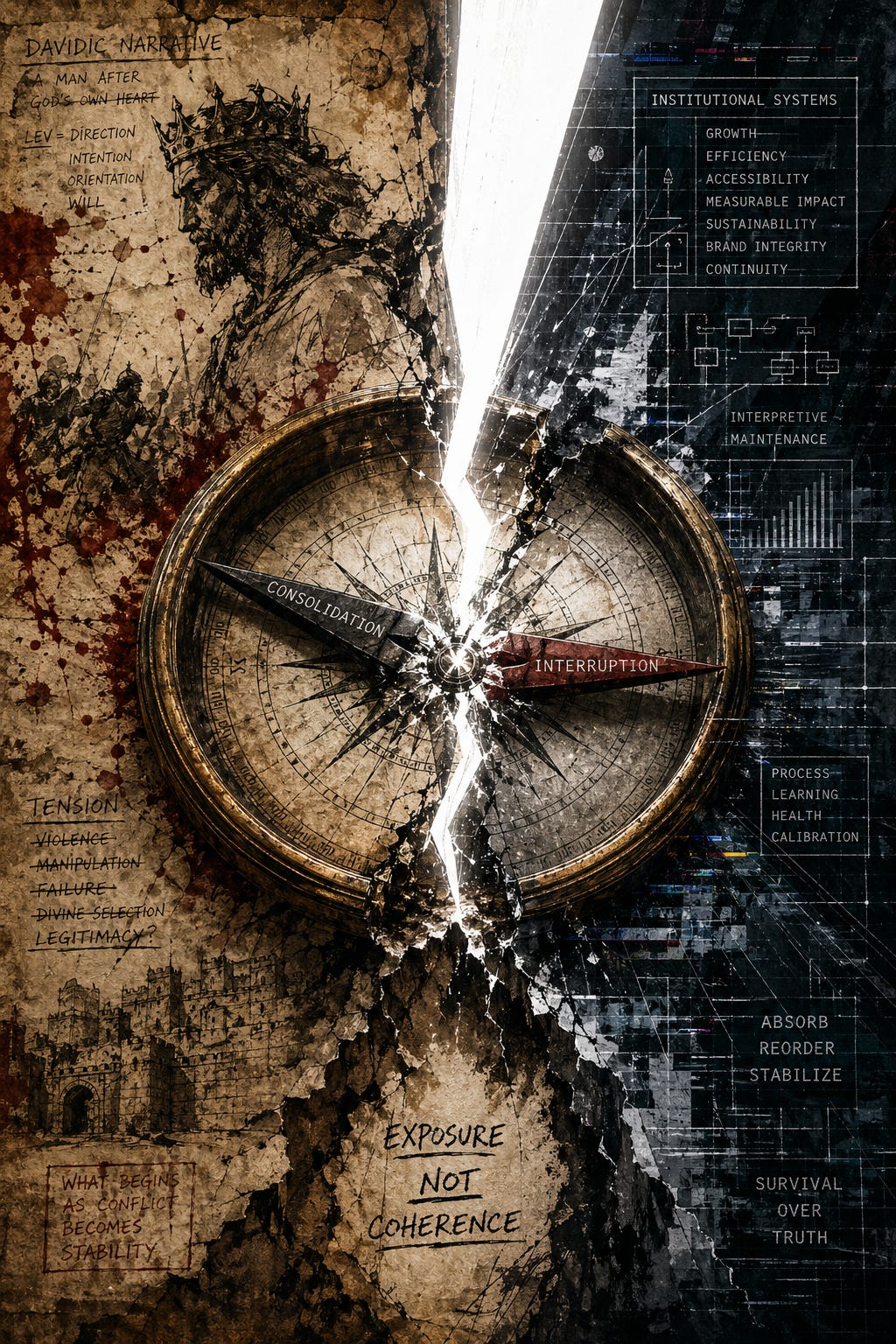
We are not primarily witnessing deconstruction.
We are witnessing moral dissonance.
Not doubt. Not rebellion. But the lived experience of two competing moral authorities claiming the same name.
I remember a conversation with a close friend not long ago about biblical literalism, and how it often appears to bypass the obvious cognitive dissonance rather than resolve it. At the time, I thought I was observing something external, something happening elsewhere, in other interpretive communities.
But I cannot keep myself outside of that observation.
While writing earlier essays on David, I realized I had participated in the same movement. I had inherited interpretive conclusions and treated them as transparent, even when the text itself was doing something more complex. The tension was present, but I had learned how to smooth it without noticing the smoothing.
That changed when I went back into the Hebrew and encountered something I had passed over before.
The word often translated as “heart” in the Davidic narrative does not carry the moral freight I had assumed. It does not function primarily as a category of ethics or inner virtue. It is closer to intention, orientation, direction of will rather than purity of conscience.
And that distinction does something that is hard to undo once seen.
Because it exposes how easily moral language can be laid over material that was not originally structured to carry it in that way.
Not necessarily wrong.
But not stable either.
From there, the question stops being local. It begins to scale on its own.
If interpretive moral weight can be introduced so easily at the level of a single term, then what happens when that same movement is repeated across an entire tradition?
What happens when leadership, authority, legitimacy, and divine approval are all read through layers of interpretation that have slowly absorbed moral assumptions that were never explicitly there?
At that point, the canon is no longer experienced as a single voice speaking clearly.
It is experienced as tension that has been organized into apparent coherence.
And that is where David stops being just a figure in the narrative and becomes something closer to a pressure point in the system itself.
Because in the Davidic stories, you do not get moral simplicity. You get consolidation and rupture in the same breath. You get political necessity and theological framing occupying the same space without fully resolving each other.
David is not presented as a clean moral archetype in the raw material of the text. He is a king whose rise is bound up with violence, whose legitimacy is narrated through divine selection, and whose failures are preserved rather than erased.
But tradition does something subtle with that complexity.
It does not remove it.
It reclassifies it.
The tension remains in the text, but it is gradually reorganized so that it no longer interrupts interpretation in the same way. What begins as narrative conflict becomes theological stability. What begins as unresolved character becomes usable moral signal.
And once that shift happens, something important changes in how the rest of the canon is heard.
Because now the Davidic frame and the Gospel frame are held inside the same interpretive space, even though they are not doing the same kind of work.
One operates through consolidation of political and theological legitimacy.
The other repeatedly destabilizes the very categories that allow that consolidation to feel morally secure.
And yet both are read together, inherited together, stabilized together.
So the tradition does not feel like contradiction from the inside.
It feels like coherence that requires constant interpretive maintenance.
And the maintenance is often invisible to the people doing it.
Until it isn’t.
And once I started seeing it there, I started seeing it elsewhere too, not as repetition of the same historical event, but as repetition of the same kind of pressure.
Because when a system survives long enough, it eventually has to negotiate with its own instability.
In the early fourth century, that negotiation takes a very visible form when Christianity moves from persecution into proximity with imperial power under Constantine. What had been a marginal and often unstable movement suddenly finds itself inside the architecture of empire, and what changes first is not doctrine but interpretation. By the time you reach Nicaea, theological language is no longer only describing belief, it is participating in the consolidation of imperial coherence. Bishops are exiled, restored, repositioned, not only on the basis of theological disagreement but on the basis of what stabilizes unity under pressure. Orthodoxy does not emerge in a vacuum. It emerges inside a system learning how to survive itself.
And what becomes difficult to miss, if you stay with it long enough, is how quickly survival begins to shape what counts as truth.
Not always explicitly. Not always maliciously. But steadily enough that direction becomes visible in hindsight.
The same logic appears again much later in the rise of modern megachurch systems where scale becomes not just a feature but a form of validation. In the late 20th century, Willow Creek Community Church becomes one of the most influential megachurches in the United States. Growth is intentional, designed, measured, optimized. Systems are built around removing friction, increasing accessibility, and expanding reach. For a time, the equation feels stable: what grows is what works, what stabilizes is what is faithful.
But then you begin to notice what that equation cannot easily measure.
Because participation does not always correspond to formation. Attendance does not always correspond to transformation. Engagement does not always correspond to moral integration.
Later internal assessments made this visible in ways that were difficult to ignore, revealing gaps between participation and spiritual formation that the system itself had not been designed to detect.
Then came rupture.
Allegations of misconduct against founding pastor Bill Hybels surfaced publicly in 2018, followed by investigations, resignations, and institutional processing that stretched across months and years.
And what becomes most revealing is not only the crisis itself, but the language available to respond to it.
Because even in moral fracture, the vocabulary tends to return to what the system already knows how to stabilize:
learning
process
health
continuity
recalibration
And you begin to see something that is not confined to one institution, but becomes easier to see there because it is no longer hidden.
The system does not primarily lose moral language.
It reorders moral language around survival.
And once you see that, earlier examples stop feeling like isolated history and start feeling like variations of the same pressure.
Not identical events.
But similar forces producing similar adjustments.
A system comes under pressure.
Something has to hold it together.
A structure, leader, or narrative emerges to stabilize it.
And almost immediately, moral language begins to shift.
What once sounded like judgment begins to sound like context.
What once sounded like rupture begins to sound like complexity.
What once demanded response begins to sound like something to manage.
But this does not happen uniformly.
There are moments where moral pressure refuses absorption. Monastic movements in late antiquity, for example, did not dissolve institutional Christianity but preserved alternative forms of life long enough to keep a different memory alive. So the pattern is not total.
It is contested.
Still, it returns often enough that it becomes recognizable before it can be fully described.
And the more I noticed it, the harder it became to ignore how often moral language was being carried by structures organized around something other than moral clarity.
Something closer to continuity.
Something closer to usefulness.
Something closer to survival.
And that is where the tension stops feeling historical and starts feeling present.
Because it is no longer only about Constantine, or institutions, or modern systems.
It is about what happens inside interpretation itself when the need to remain coherent begins to override the ability to remain honest about what is actually being seen.
And at that point, the question is no longer whether the pattern exists in history.
The question becomes what it does to you when you can no longer unsee it.
And the system does not stop speaking.
It continues to interpret, stabilize, and absorb moral tension into usefulness.
But at certain points in history—and at certain points inside a person’s own conscience—that interpretive stability begins to fail, not because the text has changed, but because what it is being used to justify no longer aligns cleanly with what is actually being read.
And this is where Jesus stops functioning as one voice among others inside the system and begins functioning as interruption.
Not abstraction.
Not symbol.
Not theological accessory to a larger structure.
But exposure.
He names what religious authority hides. He confronts moral reasoning that protects itself through interpretation. He refuses alignment with systems that preserve themselves at the cost of people, not as concept but as confrontation inside lived moments: release to the oppressed in Luke 4 as present reality, kinship reordered in Mark 3 outside institutional authority, and direct indictment of religious leadership in Matthew 23 where appearance is maintained while justice, mercy, and faithfulness are neglected.
And if you sit inside those texts without trying to smooth them, something resists stabilization.
Because what emerges is not a figure who completes a system of meaning, but one who consistently interrupts systems that attempt to make meaning safe.
Which means the conflict is not primarily between interpretations of Jesus.
It is between systems that require stabilization and a figure who refuses to participate in that stabilization when it violates what it claims to serve.
So when moral dissonance emerges, it is not because Jesus is unclear.
It is because clarity itself becomes disruptive inside structures built to metabolize contradiction without being changed by it.
And what cannot be absorbed without distortion eventually produces rupture.
Not symbolic rupture.
Ethical rupture.
A break between what the system calls necessary and what Jesus enacts as faithful.
And in that moment, what you are left with is not a reconciled tradition or a resolved tension.
It is exposure that will not settle back into usefulness without becoming something other than itself.
Not harmony.
Not synthesis.
Not interpretive closure.
But interruption that keeps interrupting.
That is what “True North” is here.
Not orientation toward stability.
But the persistence of Christ’s judgment against every structure that requires moral contradiction in order to remain coherent.
And once that is seen, it does not function as belief or position.
It functions as rupture that does not close.
And moral dissonance does not resolve.
It intensifies until something gives way.
Not the text.
Not the tradition.
But the assumption that either one was ever meant to stabilize what only exposure can hold.