Wrong Question
Before we talk about filling pews, we have to understand why they emptied.

You ask me how to get them back.
How to fill the pews. How to bring the children home. How to make Sunday morning matter again to people who used to know every hymn by heart and now sleep in without guilt. The question comes to me from pastors and church leaders. Men and women who built their lives and their vocations on a model that is collapsing under them in real time. The grief in the question is real. I want to honor that before I say what I am about to say.
You are asking the wrong question.
You do not treat a fever by arguing with the thermometer.
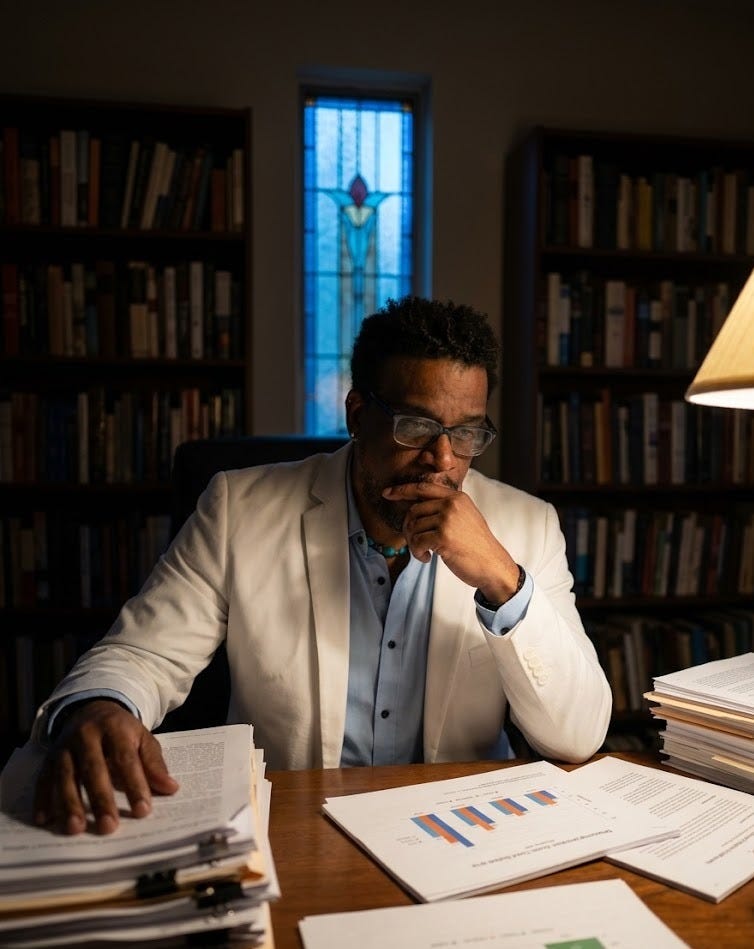
Here is what I mean. Right now, on my desk, I have the numbers. I work them like a stonemason works a difficult vein. Slowly. With respect. Because they are telling me something the institution does not want to hear.
In 1993, roughly nine in ten American adults called themselves Christian. By 2020, that number collapsed to sixty-four percent. Almost thirty points of national identity, gone in less than three decades. But the numbers are only the outline. The faces are the truth.
I have friends, colleagues, neighbors I have known for decades, who have not left the faith. They have left the church. They still live by an internal code that does not need to dress up on Sundays or perform vocal affirmations to remain intact. Some of them are quietly more Christ-shaped in their conduct than the men who still hold microphones. Others have moved past the religious label entirely and become banner-carriers for humanism, for kindness, for the kind of neighbor-love the institution kept preaching about but could not seem to practice. They are not lost sheep. They are people who looked at the shepherd, looked at the wolves the shepherd was protecting, and decided the field was safer than the pen.
Young women are leaving faster than any demographic in American history. For the first time, more women than men are walking out the doors of Gen Z’s churches. They are not leaving because they stopped praying. They are leaving because they were told their bodies, their choices, their leadership, and their full humanity were the negotiable items in the church’s settlement with power. They counted the cost and decided honesty was cheaper than belonging.
Young men, meanwhile, are surging back. Pay close attention to where. They are not flooding into mainline Protestant churches that have done the slow work of reckoning with abuse, expanding inclusion, or wrestling honestly with race. They are flooding into Catholicism, Eastern Orthodoxy, and the most authoritarian corners of evangelical and independent Christianity. Forty-two percent of them now say religion is very important, up from twenty-eight percent in two years. The institution wants to call this revival. I am not going to call it that, and I am not going to soften what it is. The surge is almost entirely political, and it is highly selective. These young men are not finding Jesus. They are finding authority. Hierarchy. Certainty. Masculine ritual. A flag with a cross stitched onto it, handed to them by men who learned they could organize a generation of frightened, status-anxious sons into a movement faster than they could disciple them into a faith. That is not the Spirit of God. That is recruitment.
So when you ask me how to fill the pews, I have to ask you something first.
Do you want to know why they emptied?
Because the honest answer is not pretty, and it is not the answer the consultants are selling. The pews did not empty because the culture got too secular, or because the kids got too distracted, or because the music got too old. Those are alibis. Comfortable ones. They let the institution treat decline as something happening to the church rather than something the church did to itself.
The pews emptied because the people sitting in them watched the institution choose.
Choose silence over the sexually abused.
Choose the powerful man over the testifying woman.
Choose the closet over the child.
Choose the political party over the gospel.
Choose the wedge issue over the wounded neighbor.
Choose the flag over the foreigner Christ explicitly told them to love.
Choose the comfort of the in-group over the radical hospitality of the table.
The people in the pews are not stupid. They watched the institution make those choices, year after year, and at some point they did the moral arithmetic and concluded that leaving was more faithful than staying. Many of them did not leave Jesus. They left a building that no longer resembled him.
I have sat at the dinner table with friends who refuse to walk back into a church. Not out of hatred. Out of self-preservation. They are not bitter. They are tired in a way that took years to earn.
My friends have read about unconditional love in scripture. They have heard sermons on it. The Jesus they encountered in the text showed unmistakable compassion. But what they see in the modern church and what I see when I sit in those pews is the moral dissonance I explored in my last essay.
And I will tell you something I do not often admit. Even when I attend, my own mind drifts toward critique. Has anything new been said? Where is the teaching? My friends who left may have asked themselves the same questions and answered them more honestly than I did. The building was full of people. The sanctuary still felt empty.
That is the diagnosis. That is what the thermometer is telling you. The fever is not the problem. The fever is the body’s response to a deeper infection, and that infection has a name, a network, a political program, and a theology. It is the slow forgery of the Christian faith into something the historical Jesus would not recognize and would oppose with every fiber of his colonized, brown, peasant body.
So I am going to stop answering the question you keep asking me.
Over the next several letters, I am going to walk you through the question you have been afraid to ask. We will look at the original Hebrew blueprint and see that its covenant was always ethical, never ethnic. We will examine the forgery. How American Christian Nationalism took the language of the covenant and inverted every ethic it was built to protect. And then we will sit across from the Man whose name has been borrowed without his consent, and let him speak for himself.
I am not writing this series to bring people back to the pews.
I am writing it for the people who already left, who suspect they had good reasons, and who are still, quietly, stubbornly, sometimes against their will, looking for the One the institution kept telling them about and somehow never let them meet.
The pews did not empty.
The people left, and they left for reasons the institution is still too afraid to read.
— Joseph
This is the threshold letter to a series called The Borrowed Flag. Part One arrives next.
Bring your questions. Leave your certainties at the door.